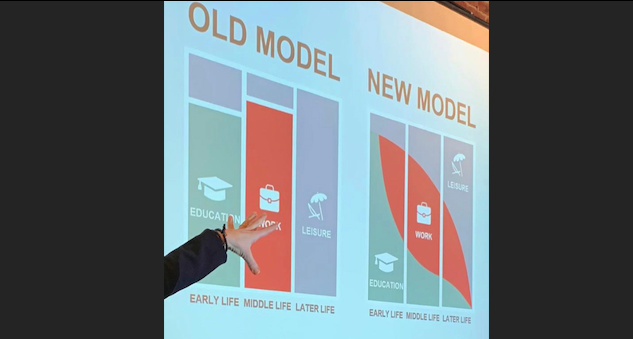
I don’t remember much about that conference. I don’t even remember who was speaking at the time. I had probably just finished work, I was probably tired, and I’m sure I had several perfectly good reasons to go straight home. But I went. And at some point, an image appeared on the screen that made me take out my phone and photograph it.
Today, I’m sharing that very same image. It showed two very different ways of looking at our lives. In the traditional model, everything seemed fairly straightforward: we studied in our early years, worked for a few decades and, at some point, retired. In the new model, those boundaries became blurred. We would live longer, our careers would last longer, we would need to return to learning several times throughout our lives, and work, learning and leisure would start to coexist in a much less linear way. Even retirement would stop being such a sharp dividing line between working and not working, becoming instead a more gradual transition — a kind of soft landing.
I’m not entirely sure why, but that image struck me. Perhaps because it put something in front of me, in a very simple way, that I had somehow already begun to sense. I took a photo, and it stayed on my phone.
A few months later, 2020 arrived, and so did the pandemic. Suddenly, we had much more time to think — or at least I did. And that image began to resonate with me even more. If we really were going to live longer, if our professional lives were going to last longer, and if the world was going to change several times during them, perhaps it no longer made much sense to organise our lives as if there were still three perfectly separate stages: first learn, then work, and finally live.
Understanding it was relatively easy. Doing something about it proved much harder.
Over the following years, I tried to move a few pieces around. To keep learning seriously, not just when my job required it. To make more room for experiences that interested me even when they offered no immediate professional return. To protect my time better. To ask myself occasionally whether I was really spending my energy on the things I wanted to spend it on. And to start imagining a second or third chapter of my professional life that didn’t necessarily have to look like the ones before it.
It didn’t happen overnight. Far from it. When you’ve spent many years operating in a certain way, inertia is powerful. Work always has something urgent to offer you. There is always another responsibility to take on, another problem to solve, or another opportunity that feels too important to pass up. Consciously reducing the space work occupies to make room for other things is much harder than it looks when you see it drawn on a chart.
A few weeks ago, now in 2026, I came across that photo from November 2019 again. This time, I wanted to know where it had actually come from, so I started following the trail. It eventually led me to the work of Laura L. Carstensen and the Stanford Center on Longevity. As early as 2014, Carstensen was talking about the need for new ways of thinking about work and education in the context of longer lives. Stanford would later develop these ideas further through its New Map of Life initiative: learning throughout our lives, working for longer but with greater flexibility, and replacing a rigid life trajectory with one involving more transitions, entries, exits and changes of direction.
Perhaps that is also why I find myself paying particular attention these days to people who are somewhere around the middle of their careers. Many sense that they need to build a different balance between the work they are doing today, the learning their future self will need, and the time they want to spend enjoying their lives. The problem is that redesigning that balance from inside the whirlwind of the old model — often while holding an extremely demanding job — is not easy. Time is scarce, but what is often even scarcer is the distance needed to ask ourselves the right questions. I believe this is where a coaching process can be particularly valuable: creating the space to pause and look at ourselves from a different perspective, question some of the beliefs that may have been shaping our decisions for years, and become more aware of what we want to preserve and what we want to change. Not so that someone else can tell us what the right new balance should be, but so that we can build our own roadmap with greater clarity.
I don’t know whether that model will accurately predict how we will live twenty or thirty years from now. Probably not. Researchers trying to anticipate the future don’t have a crystal ball either. But I am increasingly convinced of two things.
The first is the importance of exposing ourselves to what lies outside our existing mental map. Going to a conference even when we’re tired. Reading something with no obvious immediate application. Listening to someone who is researching what the world might look like twenty years from now. Models of the future don’t need to be 100% accurate to be useful. Sometimes it is enough for an idea to resonate with us, challenge one of our assumptions and help us readjust, pivot or redesign what we are doing today.
The second is that, seven years after taking that photo, I believe part of that new model is already here. For many people between 30 and 55, devoting almost all their energy to work no longer seems either desirable or sustainable. On the one hand, we will need to make time to learn, update our skills and probably reinvent ourselves several times if we want to remain relevant throughout longer careers exposed to constant change. On the other, I believe we will demand greater flexibility and set firmer boundaries around work because we also want to enjoy our interests, our relationships and our lives while our careers are happening — not only when they are over.
And between 55 and 70, another challenge emerges that I find even more interesting: how to continue creating value when many corporate structures may no longer have enough room for all that experience and, at the same time, we ourselves may neither want nor be able to sustain for another fifteen years the same level of intensity we had accepted until then. We will need to invent new combinations of work, knowledge, mentoring, projects, learning and personal time. Perhaps that soft landing I saw drawn in 2019 is not so much about gradual retirement as it is about finding a different way to keep creating value.
That evening in November 2019, I would probably have been more comfortable going straight home after work. I’m glad I went to that conference.
And you, do you make enough time and space for new ideas to enter your mental map?
Where are you on the curve, and how are you protecting learning and leisure so that your future can be both sustainable and fulfilling — personally and professionally?
Do you have a reasonably clear picture of who you want to be five years from now?
Share your perspective
If this article sparked a thought, a disagreement or a personal reflection, I’d be glad to read it.
This first version of the blog keeps the dialogue simple: write your name and your comment below, and when you send it your email app will open so it reaches me directly.